Modern vehicle security has evolved dramatically, with keyless entry systems now standard in millions of cars worldwide. While these advances offer real convenience, law enforcement professionals increasingly warn drivers about emerging vulnerabilities. Understanding these risks — and taking the right precautions — can mean the difference between a secure vehicle and an empty parking space.
How Keyless Entry Systems Work and Where They Fall Short
Contemporary car keys communicate through sophisticated electronic systems, transmitting unique digital signals to a vehicle’s security module. Each key fob contains a miniature computer chip programmed with complex algorithms capable of generating billions of possible code combinations. When you press the unlock button, the chip produces a specific electronic signature that the vehicle validates before granting access.
Security researchers from Radboud University in the Netherlands and Birmingham University have uncovered critical weaknesses in these systems. Their findings revealed that criminals can intercept a transmitted signal twice to dramatically reduce possible code combinations — from billions down to roughly 200,000. Sophisticated software can then crack those combinations within thirty minutes, granting unauthorized access to the vehicle.
Criminal organizations have also developed relay amplifier devices that capture and replicate key fob signals from considerable distances, allowing thieves to unlock cars without ever touching the keys. As this technology becomes more accessible, car theft has shifted from opportunistic crime to calculated technological assault.
Why Aluminum Foil Works as a Signal Blocker
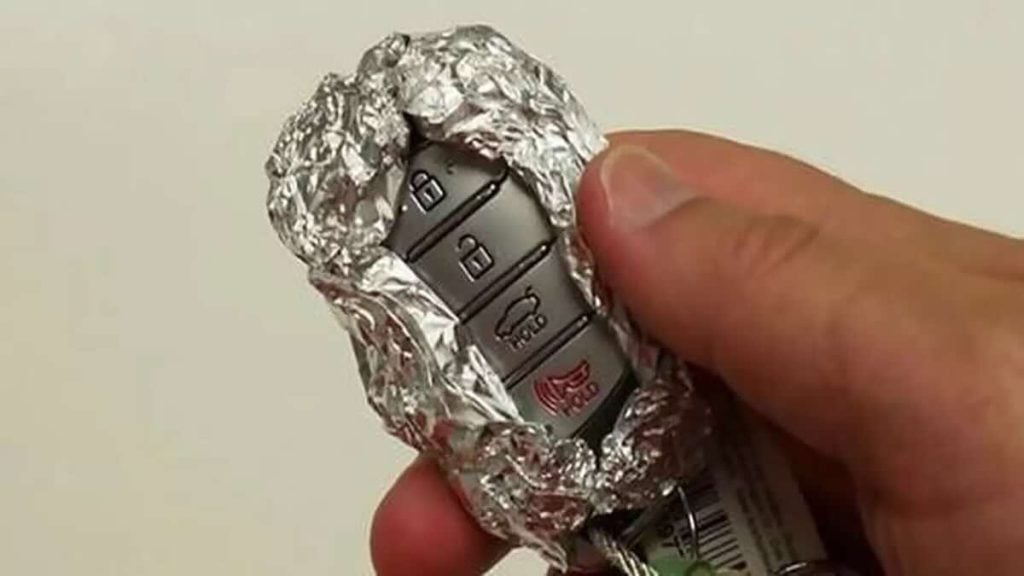
Wrapping car keys in aluminum foil creates a Faraday cage effect, completely blocking radio frequency transmissions. The metallic barrier prevents electronic signals from escaping, rendering relay amplifiers useless. Aluminum’s conductive properties redirect electromagnetic waves around the enclosed keys rather than allowing them to pass through.
Security experts recommend going a step further by creating dedicated aluminum-lined containers for key storage, rather than relying on temporary foil wrapping. A small box lined with aluminum foil provides reusable, durable protection while keeping keys accessible. Basic foil wrapping can develop tears or gaps over time, compromising its effectiveness.
The one trade-off is convenience — wrapped keys can’t transmit unlock signals until removed from their protective covering. You’ll need to take the keys out before approaching your vehicle. It’s a minor adjustment that comes with significant security benefits.
Other Effective Protection Methods
Several everyday household items can block key fob signals without any extra purchases. Refrigerators and freezers, for example, naturally shield radio frequencies through their multiple metal layers, making them viable temporary storage spots. Just keep keys away from food items to avoid contamination and ensure easy retrieval.
Unpowered microwave ovens are another option — keys stored inside a switched-off microwave are completely shielded from electronic interference. One important warning: never operate a microwave with metal objects inside, as this causes dangerous electrical arcing that can damage the appliance and create a fire hazard.
Other reliable protection methods include:
- Metal filing cabinets with secure drawer mechanisms
- RFID-blocking pouches designed specifically for key fobs
- Metal toolboxes with tight-fitting lids
- Aluminum-lined key cases from security retailers
For the most robust solution, purpose-built RFID-blocking devices utilize advanced materials that selectively block harmful frequencies while preserving full functionality when needed — eliminating the inconveniences of household workarounds.
Building a Comprehensive Vehicle Security Strategy
Protecting your keys is just one part of a broader anti-theft approach. Parking location matters too — well-lit, busy areas naturally deter criminal activity. Keeping your vehicle’s security software up to date is equally important, as manufacturer patches frequently address newly discovered vulnerabilities. If your key fob starts showing reduced range or intermittent behavior, it may be a sign of attempted signal interference worth investigating.
It’s also worth having a backup plan. Traditional mechanical keys, where available, provide reliable access when electronic systems fail or experience interference. Familiarize yourself with your vehicle’s manual door locks and ignition procedures so you’re never caught off guard during an electronic system failure.
A layered, consistent approach to vehicle security — combining signal blocking, smart parking habits, software maintenance, and backup access methods — offers the strongest protection against today’s increasingly sophisticated car theft techniques.